


Fleet extension will allow Dniproavia to become the largest Embraer operator in Eastern Europe
Conteúdo
São José dos Campos, January 31, 2011 – Embraer and Dniproavia, a member of the Ukrainian Aviation Group Alliance, came to an arrangement, today, regarding the delivery of ten EMBRAER 190s, with options for another five jets. The aircraft will be operated by Dniproavia, in cooperation with another alliance member, AeroSvit, and will be placed under a lease structure to be arranged by a third party. The total value of the deal, at list price, is US$ 400 million, based on January 2010 economic conditions, and could reach US$ 600 million if all options are confirmed. This value will be added to the current Embraer firm order backlog.
“There is no greater sense of satisfaction for a manufacturer, like Embraer, than to expand its customer base and welcome a new partner into the E-Jets family, especially in Eastern Europe,” said Paulo César de Souza e Silva, Embraer Executive Vice President, Airline Market. “We are very proud to be part of the solid growth of the Ukrainian Aviation Group. We already have a successful partnership with Dniproavia, which ERJ 145 fleet will reach 25 planes this year, and we are confident that the performance capabilities of the EMBRAER 190 will allow Dniproavia and its partners to satisfactorily spread its wings into the European market.”
Dniproavia’s EMBRAER 190 jets will be configured in a comfortable dual-class layout, seating up to 104 passengers. The first two aircraft are scheduled for delivery in the fourth quarter of 2011. All ten airplanes will serve Alliance’s domestic and international destinations mainly from their Kiev Boryspil (KBP) hub.
“The strong brand awareness, economics and performance in combination with high level of cabin comfort for our passengers are the key drivers in the selection of the state-of-the-art EMBRAER 190 jets. Operating E-190 alongside our narrowbody aircraft will allow us to substantially expand our domestic and intra-European network,” said Vadim Shvitay, Executive Secretary of Ukrainian Aviation Group.
About the Ukrainian Aviation Group
The Ukrainian Aviation Group is a strategic alliance founded at the beginning of 2007 between two Ukrainian airlines: Donbassaero (www.donbass.aero) and AeroSvit (www.aerosvit.com). In October 2010 Dniproavia (www.dniproavia.com) officially joined the alliance. One of the main tasks of the alliance is to increase the competitiveness of its members at international markets and, as a consequence, improve the national air transportation industry of Ukraine. The cooperation involves operational and commercial matters including optimal fleet mix. The companies are developing suitable international connections at the Boryspil International Airport (KBP), in Kiev, to maximize synergy effect.
Source: EMBRAER 
Monday, January 31, 2011 |
Posted in
airports,
commercial,
industry
|
Read More »
 HUNTSVILLE, Ala., Jan. 31, 2011
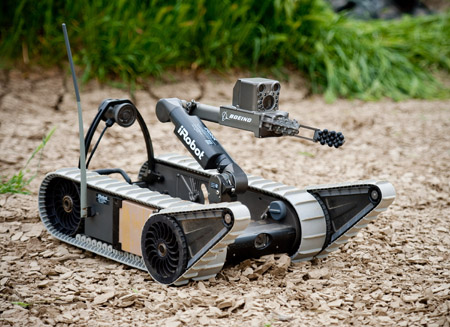
 -- The Boeing Company [NYSE: BA] and partner iRobot Corp. [NASDAQ: IRBT] today announced that they have delivered the first 30 Small Unmanned Ground Vehicles (SUGV) under a contract with the U.S. Air Force for the service's Explosive Ordnance Disposal (EOD) team. This is the first task order of an indefinite delivery, indefinite quantity contract which runs through September 2012.
"We are pleased to work with iRobot to enable Air Force EOD technicians to perform reconnaissance while reducing their exposure to unexploded ordnance," said Mike Huddleston, Robotics program manager for Boeing Network & Tactical Systems.
"Unmanned ground vehicles have been saving lives for years on asymmetric battlefields," said Robert Moses, president of iRobot's Government and Industrial Robots division. "SUGV represents an important advancement in UGV technology because of its light weight and state-of-the-art capabilities. It gives warfighters the ability to deploy the robot at a moment's notice when faced with a variety of dangerous missions."
Boeing and iRobot developed the SUGV family of vehicles under a strategic alliance that began in 2007. The robot is designed to give warfighters real-time awareness of critical situations and allow them to complete missions from safe standoff distances. SUGV is ideal for a variety of mission types, including EOD, route clearance and reconnaissance. As the prime contractor, Boeing provides program management, contracts, and quality-control support from offices in Huntsville. iRobot is responsible for engineering, design, manufacturing, training and logistics services, with the majority of work conducted in Bedford, Mass.
iRobot designs and builds robots that make a difference. The company's home robots help people with smarter ways to clean, and its government and industrial robots protect those in harm’s way. iRobot's consumer and military robots feature iRobot Aware® robot intelligence systems, proprietary technology incorporating advanced concepts in navigation, mobility, manipulation and artificial intelligence. For more information about iRobot, visit www.irobot.com.
Boeing is the largest aerospace company in Alabama and one of the state's largest employers. Current company operations in Huntsville include the Ground-based Midcourse Defense program and other missile defense work, such as the Arrow system and the Patriot Advanced Capability-3 seeker, as well as work associated with Ares I, the International Space Station, Army Integrated Logistics, Brigade Combat Team Modernization and engineering for the 787 and the P-8A Poseidon.
Source: BOEING
Monday, January 31, 2011 |
Posted in
army,
commercial,
defense,
industry
|
Read More »

CHICAGO, Jan. 31, 2011 /PRNewswire/ -- Boeing (NYSE: BA) today released the following statement, responding to public reports that the WTO panel deciding European Union claims of U.S. government assistance to Boeing has issued a confidential final ruling rejecting the vast majority of Europe's claims:
"Today's reports confirm the interim news from last September that the WTO rejected almost all of Europe's claims against the United States, including the vast majority of its R&D claims – except for some $2.6 billion. This represents a sweeping rejection of the EU's claims.
"Nothing in today's reports even begins to compare to the $20 billion in illegal subsidies that the WTO found last June that Airbus/EADS has received (comprised of $15 billion in launch aid, $2.2 billion in equity infusions, $1.7 billion in infrastructure, and roughly $1.5 billion in R&D support).
"The WTO's decisions confirm that European launch aid stands alone as a massive illegal subsidy only available to Airbus, which has seriously harmed Boeing, distorted competition in the aerospace industry for decades, and resulted in the loss of tens of thousands of good-paying U.S. jobs.
"Today's decision will not require any change in policy or practice, or other remedy that comes close to approaching the billions of dollars of launch aid that must be repaid by Airbus or restructured on proven commercial terms. As a result of the June WTO ruling, EU governments and Airbus/EADS must repay or restructure $4 billion in still outstanding illegal launch aid subsidies Airbus received to develop the A380. They must also remedy the adverse effects of the additional $16 billion in other illegal subsidies Airbus received.
"Under the WTO's decisions, Airbus must now compete in the global marketplace without the massive illegal subsidies it has received since its inception and without which, the WTO held, Airbus would be 'a much different, and we believe a much weaker' company than it is today. It will be required to finance airplanes the same way Boeing does – with its own money. Having recently announced it has more than $13 billion dollars of cash on hand, Airbus should have no problem with this new requirement.
"Today's ruling underscores our confidence in the WTO processes and dispute-resolution procedures. We applaud the body for its work and continue to look to Airbus/EADS and the EU to recognize that in today's global market, everyone must play by the rules and abide by WTO requirements. Playing by the rules, for Airbus/EADS, means withdrawing the still-outstanding A380 prohibited launch aid subsidy and financing the A350 on commercial terms. Airbus should confirm its intention to comply with the WTO's decisions."
Editor's Note: More information about the WTO cases can be found at www.boeing.com/WTO.
Source: BOEING
Monday, January 31, 2011 |
Posted in
commercial,
industry
|
Read More »

Today’s World Trade Oganisation (WTO) decision confirms that Boeing has received massive and illegal government subsidies for many decades, and that they have had a significant and ongoing negative effect on European industry.
The final WTO-report to be publicly released in a few weeks can be expected to say:
1. Boeing would not have been able to launch the 787 without illegal subsidies.
2. Boeing has received at least $5 billion of US taxpayer dollars which has been determined illegal. Quantification of the additional subsides beyond this figure will take place in later stages of this dispute if Boeing chooses to pursue it.
3. An additional more than $2 billion in state and local subsidies that Boeing will receive in the future are illegal.
4. The effect of the subsidies is significantly larger than the face value of the subsidies in light of their particularly pervasive nature.
5. The pervasive subsidies have thoroughly distorted competition within the aviation industry, directly resulting in significant harm to the European aerospace industry.
6. The effect of these subsidies will continue in the future, putting Airbus at a significant disadvantage.
In concluding that Department of Defense (DoD) and NASA funding are illegal subsidies, the WTO decision will require fundamental changes to the US funding mechanisms.
The WTO decision will also confirm that Washington State and the City of Everett must stop subsidising Boeing. Unless stopped, these subsidies will increase annually through 2024.
The WTO can be expected to say that the billions in subsidies benefiting Boeing have a significantly greater distortive effect than the Reimbursable Loans to Airbus. Airbus estimates at least $45 billion as a realistic figure based on identified lost sales to Airbus as a result from the subsidies. Taking the cases together, the WTO will be seen to now have specifically green-lighted the continued use of loans in Europe and commanded Boeing to end its illegal R&D cash support from NASA, DoD and the US taxpayers.
“Airbus applauds the excellent result achieved by the European Commission and the Member States. From today, Boeing can no longer pretend that it doesn’t benefit from generous and illegal state subsidies. It has been doing so from the start and it’s time to stop the denial,” said Rainer Ohler, Airbus’ Head of Public Affairs and Communications. “We expect the WTO dispute to carry on for several more years and as in all trade conflicts, a resolution will only be reached through negotiations. The myth that Boeing doesn’t receive government aid is over and we hope this sets the tone for balanced and productive negotiations going forward.”
Source: AIRBUS

Monday, January 31, 2011 |
Posted in
commercial,
defense,
industry,
science,
space
|
Read More »
Monday, January 31, 2011 |
Posted in
|
Read More »


